>> The bandwidth from Curiosity directly to Earth is about 8 kb/s. Curiosity has a high bandwidth link to the Mars Odyssey Orbiter, a Mars satellite, which has a 256 kb/s link to Earth.
The early pictures are from a low resolution camera with a clear dust cover still attached. This camera is used to determine if Curiosity is about to land in a crater. A higher resolution camera will be activated later. <<
While yes, the original pictures from the low res camera look bad, the new raw pictures from the higher-resolution cameras aren't really that much better.
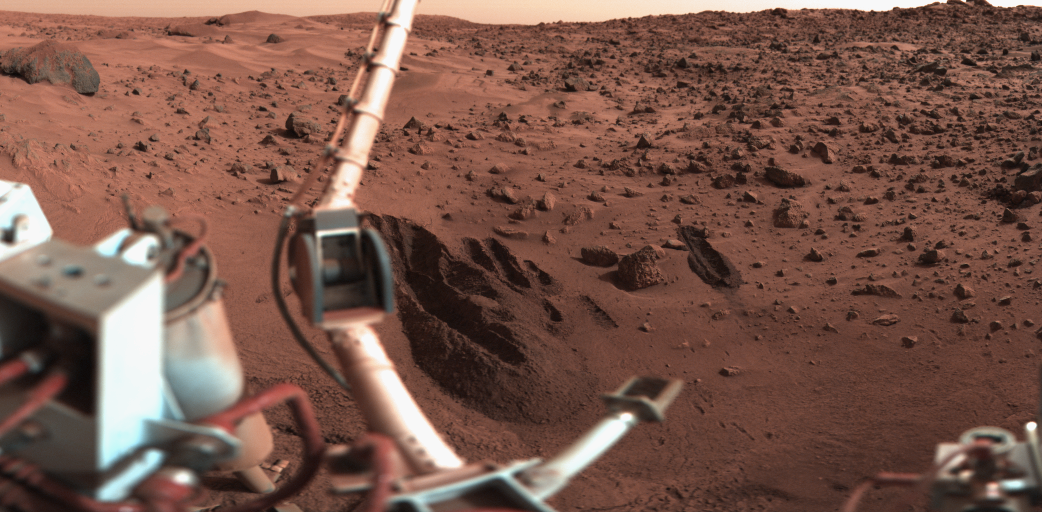
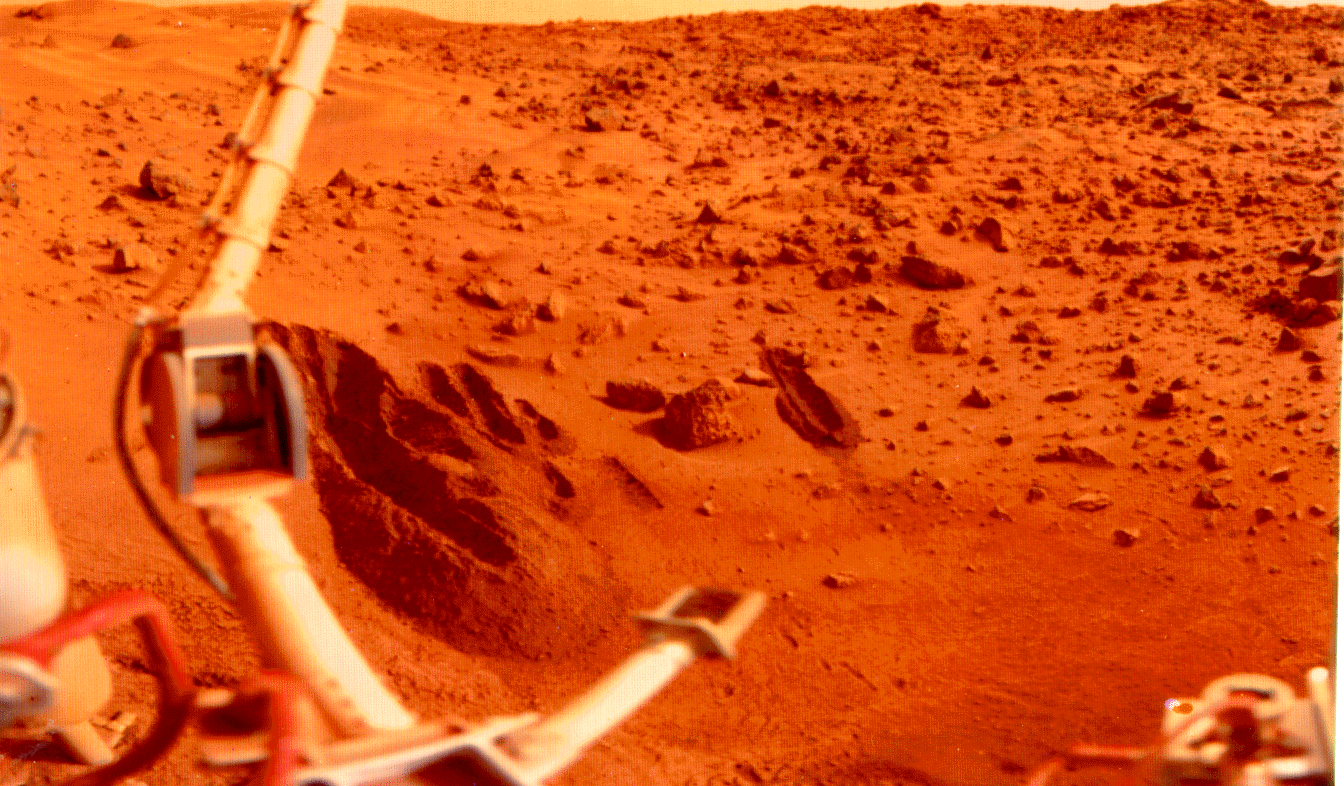
Better than the images from the iPhone 1, probably. But better than Viking 1 images from 1976? Honestly, it doesn't look like it.
Just look at the detail per pixel. It's amazing. You can see tiny details in the sand.
It's looks like if you took an image on a 20 megapixel DSLR with a high-quality lens, then scaled the image down to web size. The resolution isn't higher than a camera-phone, but the detail is remarkably better. And that's from nearly 40 years ago.
when Mr Van der Hoorn "used the original 11d128.blu, 11d128.grn and 11d128.red images from the NASA Viking image archive, converted them to .png, manually removed the noise and finally merged them into one image"
While yes, the full color image I posted was re-compiled from the original red, green, and blue channel images sent from the rover by a non-NASA source, even NASA's B&W images look better back then than they do now.
Remember that the images we have from Curiosity so far are from the navigational guidance cameras, though. The heavy equipment hasn't been fired up yet.
If I recall, the Mastcam will take a panoramic colour view later today, and that'll take a few days to download. Then we'll have a proper image, for the first time.
Here is the panaromic view from Mastcam. But as you can see by image's description, we're all still waiting for the big picture though!
Excerpt from [1]:
"As engaging as this color panorama is, it is important to note this is only one-eighth the potential resolution of images from this camera."
[1]http://www.nasa.gov/mission_pages/msl/news/msl20120809.html
Interesting. I'm just going on a hunch here, but maybe getting better photographs of the Mars surface is not a priority anymore? From the wikipedia page of Mars Science Laboratory the goals of the mission are:
To contribute to these goals, MSL has six main scientific objectives:
* Determine the mineralogical composition of the Martian surface and near-surface geological materials.
* Attempt to detect chemical building blocks of life (biosignatures).
* Interpret the processes that have formed and modified rocks and soils.
* Determine present state, distribution, and cycling of water and carbon dioxide.
* Characterize the broad spectrum of surface radiation, including galactic radiation, cosmic radiation, solar proton events and secondary neutrons.
By those I can understand why carrying a high res camera was not a priority because it would have added weight, taken up space and also consumed more bandwidth while transmitting? :)
I'm psyched they have a camera that can take true color images! Now we can see what Mars looks like without false color filtering. I wonder how close they get with those techniques to the real thing.
Normal "color" cameras are also false-color filtered. They just have the filters applied per-pixel instead of over the whole sensor at once. http://en.wikipedia.org/wiki/Bayer_filter
It's from O'Reilly's "Beautiful Data", made available free in honor of the current mars mission.
The short answer (covered in that document) is actually that the sensors have to be hardened for space use and are not consumer grade. They are incredibly expensive to produce.
The main camera, not yet deployed, can take 1600x1200 full-color pictures and HD video at 10fps. There's actually two of it, so it can also make 3D images/video. Other features are wide/telephoto lens, panorama stitching and 8GB flash storage.
Before complaining about resolution, this is like having a GoPro 3D on Mars, it has plenty of detail.
One of the articles mentions that the cameras are provided by the same manufacturer as the Viking missions, so they must certainly have improved. Expect some awesome images in the coming months!
If I had to guess - and I do, because I don't work for NASA - it's because there's a limited payload space on board, and visible images are some of the least interesting things, science-wise, that you can ask from Mars. Combine this with the electronics-unfriendly environment, and you probably aren't going to be strapping huge DLSR's on a 2.5 billion dollar science machine.
Edit: Also, these appear to be the navigation cameras, so they're probably just good enough to be able to point the rover in a direction free of road hazards and tell it to boldly go where no other machine has yet gotten around to going.
I doubt that is the reason, the weight of a 16mp sensor or marginally more than a 2mp one. The metal camera supports are much likely to dwarf the sensor weight differences.
most of a DSLR's weight is lens and battery(s), both of which are not issues in this case, since the lens would be the same and the power comes from a nuclear battery.
NASA couldn't just bolt on a 5DmkIII and expect it to work because the electronics would be fried.
That said, the Apollo missions took a not-very-modified Hasselblad camera with them that worked fine, which is why we have much higher resolution pictures of the moon, despite it being decades ago.
> That said, the Apollo missions took a not-very-modified Hasselblad camera with them that worked fine, which is why we have much higher resolution pictures of the moon, despite it being decades ago.
That and the fact that they used sneakernet, which is still much higher bandwidth than wireless, especially in space.
In the past years, while your mother played in the sunlight and your father smiled at girls and drank cool drafts as the evening drew in, before you were even a glimmer or a sunbeam, we had devices called "film cameras".
These "film cameras" did not have electronic components. They worked by using levers, springs and wheels. An emulsion that is reactive to light was prepared and pasted onto a plastic film. The plastic film was exposed to the light, but briefly. Later a complicated process was applied to transfer the reacted image (for that is what it was) onto other media, which could then be copied.
If one looks upon The Sacred Ebay (all bless the name of Sacred Ebay) one will find similar devices today.
Wherein the effects of radiation on films is documented. The answer is that some damage occurs, but films are fogged only by extreme conditions such as those that STS-31 got hit by. I don't know what steps were taken by apollo to protect films, but I would not be surprised if some protection was used to prevent excessive damage.
Also I would point out that Apollo missions were 8 days in length while the martian missions are 9 mths long (if they smash into Mars at 13k kmph) or hopefully 24 mths + long if they work - hence the serious need for hardening.
Anyway - if you like don't believe in it all - the rest of us are happy looking at the photos, data and science and enjoying the general idea. You can believe in invisible pink unicorns or ghosts or something instead if you like! (we don't mind)
Not at all, the hardening is for electronic components, the Hasselblad camera is all mechanical. The astronauts would have had to store the film in lead lined containers, but they had the advantage of bring the films back with them. Curiosity has to rely in electronics to get the images back to earth because it's staying there.
You also have to factor in that the camera needs to withstand take-off, deep space flight for months (hello radiation!), 11g's on re-entry, heat of re-entry and landing. Along with lasting for at least 2 years on Mars with no spare parts in sub-zero temperatures.
There's a reason why they don't send the latest and greatest camera or computer technology into space.
> most of a DSLR's weight is lens and battery(s), both of which are not issues in this case, since the lens would be the same
Only true if you assume the same sensor area for the 2MP sensor and the 16MP sensor, which is a poor assumption. If they did use sensors with the same area you would pay dearly with high noise and low sensitivity just to cram more pixels in there. I think most photographers figured out awhile ago that the "Megapixel War" is only meaningful as a way to pitch perceived quality to uninformed consumers.
It has only a 2 megapixel sensor, which is a shame. I am sure that it has something to do with radiation hardening and the other environmental factors.
It would be good though if NASA did catch up with sensor technology. I suspect the 2MP sensor was approved years ago when it was state of the art.
Yup, this mission has been in the works for ~10 years so I would imagine that they chose the specific sensor at least 6-7 years ago.
Also NASA is notoriously risk averse (for good reason). Apparently it is very common for them to rely on old but proven technology. Some of this has to do with risk aversion, but I imagine some of it also has to do with budget. It pains me to think what NASA could be doing with 10x more money.
>It pains me to think what NASA could be doing with 10x more money.
Me too, but pretty much it all ends going to Lockheed anyway whether it comes via the DoD or Nasa. I don't mean that conspiratorially either, even JPL people joke that JPL stands for "Just Procure Lockheed". The subcontractors rarely get mentioned in Nasa PR, but Nasa is really a whole bunch of different project offices spread over a few campuses with an enormous ecosystem of subcontractors.
I expect a vertical, strongly-led skunkworks style structure with guaranteed funding for several continuous years (vs "start working on this now but we can't promise we won't change our minds in 12 months" which causes a lot of subcontractors to not properly commit to new hires or other big capital commitments, and having to spread all the work evenly among different states) would probably yield 10x as much for exactly the same money.
Regardless of all that organizational arm-chairing (though I work in this space, hoho), Curiosity is bloody fantastic and I am very excited to follow its progress over the next year at least.
Camera chat: fewer bigger pixels = less ccd noise - remember Mars further away from the Sun than Earth, and so it's generally darker. Take an Iphone 1 photo of things at twilight to appreciate some of the difference!
The Just Procure Lockheed thing is never heard around JPL. I'm not doubting that someone said it, some time, but that's not the Lab mindset at all. If you want to make an institutional characterization about JPL, you could say "hardware-centric", or "arrogant", or "cocky", but not "Just Procure Lockheed".
I agree that there are a lot of subs, but JPL and other centers have a very strong interest in maintaining a core capability in strategic areas. Launch vehicles: not a core capability, and commercially available -- subcontract these. Planetary robotics and deep space communication: core capabilities -- keep in-house.
Also, your comment underestimates how much distributed expertise is required to develop and integrate a set of instruments like this, and to get it to Mars. It's not practical for all that expertise to be NASA only.
I recently saw a lecture on a proposal for an upcoming space mission and the speaker mentioned the contractors at Lockheed working on the proposal several times. I remember because it kind of stood out to me that they're involved from the start.
A lot of large launches are done by United Launch Alliance (ULA), which is a Boeing/Lockheed-Martin consortium. (I.e., they provide the rocket and the launch facilities -- for instance, they did all the Shuttle launches, as well as the MSL launch.) You'd have to involve them at an early stage to get costing worked out.
There's a second consortium, also Boeing/Lockheed-Martin, that does manned space operations for Shuttle (formerly) and for Station. (Operations = flight control from the ground, post-launch. E.g., rotating the solar panels on Station.) That one is called United Space Alliance, or USA for short. Catchy, no? ;-) AFAIK, USA does not play any role in unmanned operations.
As the GP pointed out, there is a lot of money in launches, launch vehicles, and in manned operations, hence the contractor involvement. As you can guess -- you can't even play Boeing off against Lockheed-Martin because they're in a consortium -- that world is kind of creaky. SpaceX is disrupting ULA big-time.
Lockheed-Martin is also involved in instrument design and other non-launch activities. Getting an instrument into space is a multifaceted affair.
Here's a good example. Juno, a spacecraft currently on its way to Jupiter:
Managed by JPL, spacecraft by Lockheed-Martin, science PI is at SWIRI, instruments from all over. And this is a "medium-size" mission, not a "flagship" mission like MSL or James Webb.
Which would explain the >10x success SpaceX seems to be having (shooting for something less ambitious than Curiosity so far, but I wouldn't be at all surprised if they put a man on Mars in 12 years for less than 10% the cost of a NASA mission.)
I don't think the megapixel count on the sensor is the result of a decision made a long time in the past. The sensor is a CCD from Kodak, which still makes very high resolution sensors at low megapixels[1]. I'm not familiar with the requirements of the sensor, but I'm sure that it was specifically selected. If NASA wanted more pixels, they were available.
Sure they have a 2 megapixel camera, but there are probably good reasons, of which you mentioned one I can think of. The other being that they can only send back limited data which has to contest with scientific experiments and navigation data, and they can take multiple 2MP shots to make a panorama like they do, effectively making a higher res image (assuming they can zoom).
More megapixels isn't necessarily better. The sensor was probably chosen for a specific reason, one reason may be that the sensor was matched to the optics (lenses) they decided to use...




Why do images from landers like this always look like there were taken from a iPhone 1's camera?