People are drawn to this sort of thing because it evokes a certain sense of accidental surrealism. When you see an image like that in the middle of watching something else, your brain reacts to it. A good example might be the twins from The Shining, which Kubrick borrowed from Diane Arbus.
There's an artist by the name of Stan Brakhage who built an entire career out of exploring this effect. And once you watch one or two of his films you begin to see his influence everywhere.
I was watching some old episodes of "The Young Ones" on NetFlix a while back, and noticed that they did this in their show quite a lot - each episode had at least one or two images inserted randomly in them for a split second. Nothing to do with the episode story at all.
I was intrigued because I never noticed them decades ago when watching the original series - they are far more obvious to me now. Must have been a common technique at the time, because I remember watching another English show from the same era (the name of the show escapes me), which did the same thing.
That was the OTHER thing that freaked me out when I finally noticed it only recently. I thought he/she was only in a couple of scenes, but then I read a blog post about it which showed him/her in a myriad of other scenes that I had completely missed too!
It looks like an in-joke of the production team. To be fair, The Young Ones was already quite surrealistic in its humour (e.g., a talking Glaswegian hamster).
A close variation of test card G on that page is common in a long list of countries, as it came from a highly successful commercially available test-card generator, and the pattern has since been copied and modified all over the place:
That's a great link, thanks. I was actually looking for an image of testcard 61 (at the bottom of that page), a copy of which I saw being used only a few years ago!
57 is interesting too; the black square in the centre is actually a hole leading into a box lined with black felt, to provide a black reference.
The generation and use of test cards and patterns is a surprisingly complicated subject; even in the digital age.
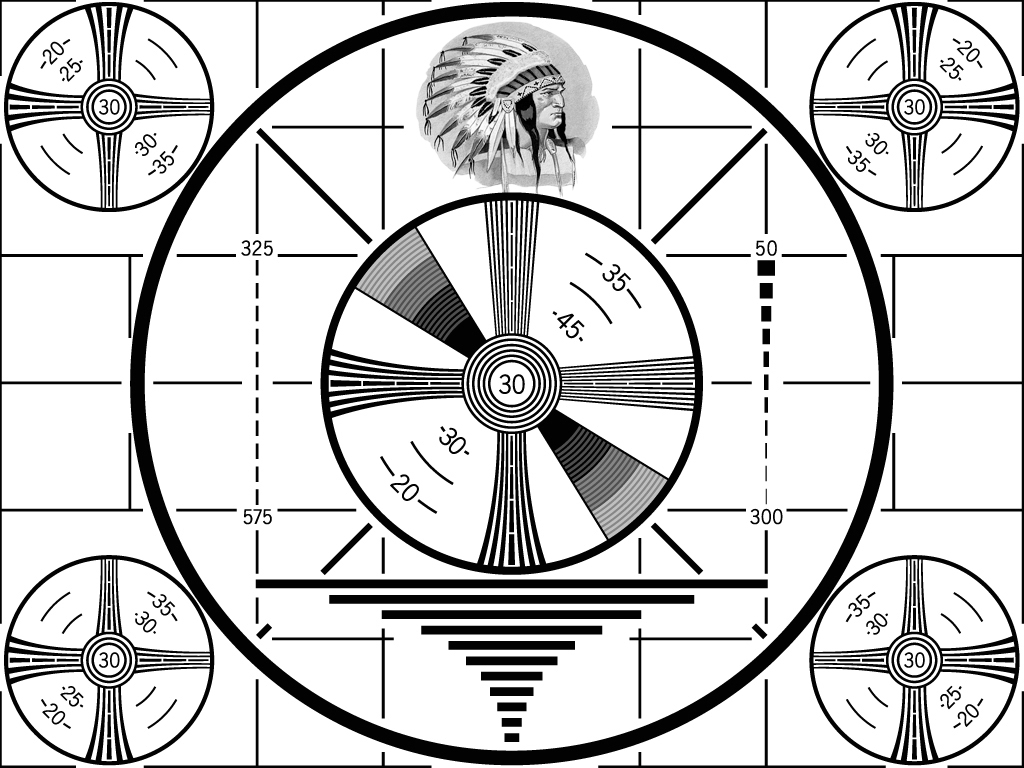
A popular test card in the US, which you can still see in some digitizations of black-and-white era recordings, is RCA's "Indian Head" card, named after the line drawing at the top for subjective sharpness checking:
I'm rather fond of that test pattern because it was usually generated by a dedicated piece of hardware that scanned a CRT beam across a metal plate with the image on it. This was to produce a more reliable source image than the more common practice of pointing a camera at a test card in the studio - and is an odd predecessor to today's test-pattern generators.
If she's 'X', then playing in the bottom-center square will put the game on the path toward a cat's game. Perhaps the puppet is strong AI, and she's trying to teach it that in some games, the only winning move is not to play.
Fascinating. The term most likely had nothing to do with the Bowie song (which apparently was inspired by one of Iggy Pop's romantic interests, who was Vietnamese). But it does suggest some interesting (unintended) interpretations of the lyrics: the "China Girl" not a fetish object, or even simply an unattainable romantic partner -- but rather a talisman, or a blank slate; which, the more you look at, the more you project into.
Or in Bowie's words,
When I look at my China girl /
I could pretend that nothing really meant too much /
When I look at my China girl /
I stumble into town just like a sacred cow /
Visions of swastikas in my head /
Plans for everyone /
It's in the whites of my eyes
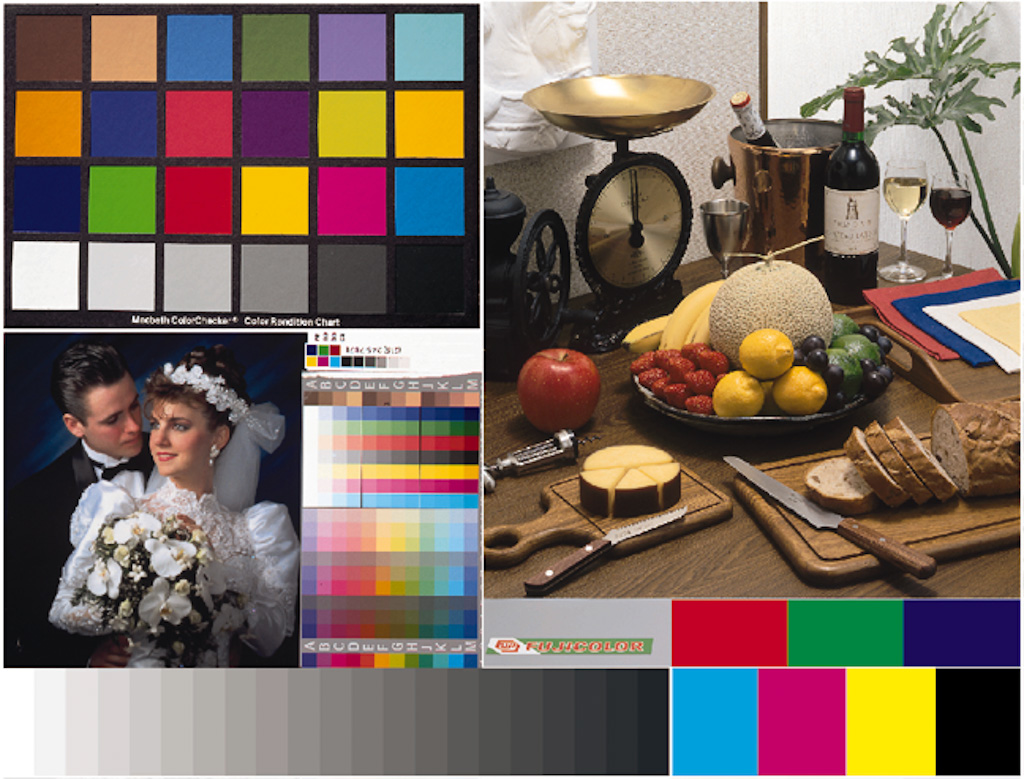
> By the 1990s, it was finally dawning on film creators and processors, too, that using a white-skinned person as the universal standard was short-changing people of every other skin tone.
I don't quite understand this statement. The point of the China Girl was having a fairly agreed upon color to make sure the film was developed properly.
As long as you were pretty sure what the color was supposed to be, you could kind of judge how good the film was.
Introducing other ethnicities would defeat the purpose.
Here's an article [1] expanding on the issue. Quoting: "If you exposed film for a white kid, the black kid sitting next to him would be rendered invisible except for the whites of his eyes and teeth".
Apparently, the ones who brought up the issue were not concerned citizens, but wood and chocolate manufacturers.
Interesting. So no matter what, it's impossible to get a "perfect exposure"? As in, there is only a perfect exposure for a shot, not a platonic idea of a perfect exposure for every color situation.
As the white husband of a brown wife, let me tell you, group selfies where I'm the only white guy in the picture invariably leave me washed out. Sometimes I make a point to expose for my face and everyone else darkens too much.
The problem is not only exposure, but how to fit the complete luminance range in the very limited emission range of a screen or a photograph after capture, and the answer is definitely "not linearly".
Actually with film it wasn't that straightforward:
"In the early days of color film, the color balance of the film’s processing chemicals were made with the primary consumer market in mind–which, at the time, was predominately light skinned individuals. “For many decades, chemicals that would bring out various reddish, yellow, and brown tones were largely left out,” explains the video’s narrator."
You do that by holding swatches of known colors and calibrating that way.
If you have say mixed race models or models of a race you're not familiar with, it would be worse than useless. Somebody with east asian features but western european skin tone would throw off an entire movie.
Yes, but it's not as though western Europeans all have exactly the same skin tone either - you can still make the wrong assumption. I think the idea would be to have multiple people with different skin tones so that you can check that they all look ok.
Reminds me of the intro to Ingmar Bergman's Persona. I guess that may have be an allusion to this, as well as Brechtian Alienation technique/"breaking the 4th wall".
Very interesting. I worked in a theater at a time when reels still were assembled and test screened usually the night before. Got to see the machines and operation up close and personal. Very technical and highly engineered equipment. Closer to clocks and watches than run-of-the-mill consumer equipment - might be of interest to have a look at the history of the devices!



There's an artist by the name of Stan Brakhage who built an entire career out of exploring this effect. And once you watch one or two of his films you begin to see his influence everywhere.